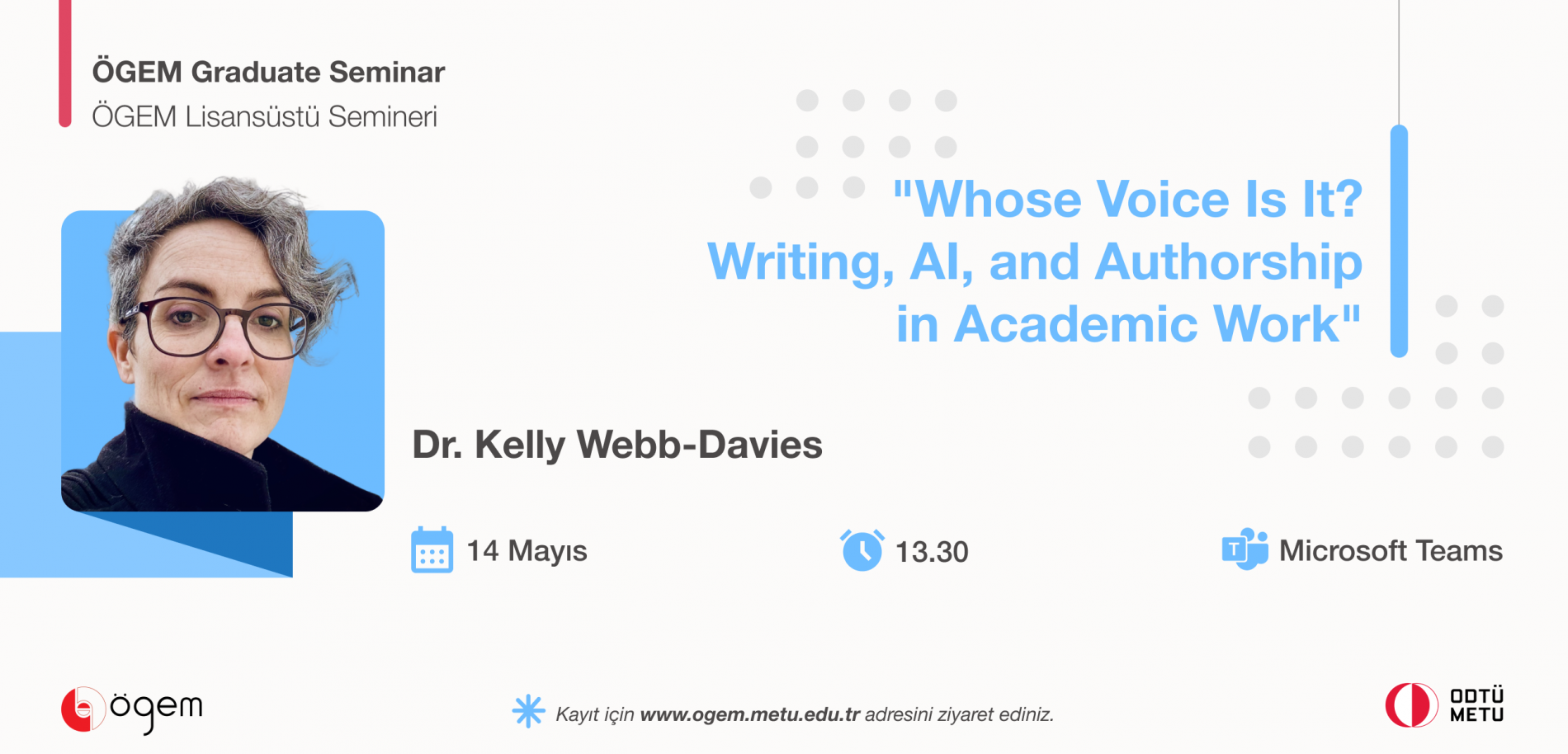
Whose Voice Is It, Writing AI and Authorship in Academic Work
Dear Graduate Students,
The Center for Advancing Learning and Teaching (ÖGEM) organizes an online seminar titled "Whose Voice Is It? Writing, AI, and Authorship in Academic Work" The seminar will be held in English. Detailed information about the seminar is provided below.
Speaker: Dr. Kelly Webb-Davies
Date: May 14, 2026, at 13:30 PM
To participate in the seminar, please click here to fill out the registration form. Teams link will be sent to registered students.
Sincerely,
Center for Advancing Learning and Teaching
------------------------------------------------------------------------------
SEMINAR CONTENT
Generative AI is rapidly becoming part of academic writing, particularly for researchers working in a second language. While these tools can support clarity and expression, they also raise important questions about authorship, voice, and what it means to produce academic work.
This seminar explores how writing with AI can be understood as a form of mediated thinking rather than a loss of originality. Drawing on the framework of Digitally Enabled Translanguaging for Academic Purposes (DETAP), Kelly Webb-Davies will show how academic writing can be seen as a process of developing ideas and then shaping their expression, often with the support of digital tools.
The session will also introduce practical approaches to using AI in ways that preserve intellectual ownership, maintain your voice, and support more accessible and equitable academic communication.
BIO
Kelly Webb-Davies is the Lead Education AI Consultant at Oxford University's AI Competency Centre. With a background in linguistics and experience teaching English for Academic Purposes, she focuses on integrating AI into higher education in practical and inclusive ways.
Her work centrescenters on rethinking academic writing and assessment to better reflect how people learn, communicate, and demonstrate knowledge in a world where AI tools are readily available. Her approach focuses on using AI to support communication, reduce bias, and improve access to learning, particularly for multilingual and neurodivergent students. She advocates for approaches that combine human expertise with AI to enhance, rather than replace, critical thinking.